Leadership and Impact
Welcome to my most impactful leadership experiences, feel free to read more about Kijani World and African Leadership Academy in the articles below
Kijani World
Growing up, my grandparents taught my cousins and me the importance of giving back to nature. In Indigenous Kenyan culture, this was more than just a belief—it was a way of life. Planting trees wasn’t just an act of conservation; it was a tradition woven into our celebrations—birthdays, family gatherings, milestones—each marked by planting something new.
As we grew older and learned more about the impact of rising CO₂ levels, we asked ourselves: What role can we play? We realized that climate action doesn’t have to feel overwhelming—it can be woven into the things we already love and do. This idea led to the creation of Kijani World (Kijani means "green" in Swahili), an initiative designed to make environmental conservation accessible, engaging, and part of everyday life.
Through Kijani World, we created diverse pathways for Kenyan youth to take part in climate action based on their own skills and interests.
-
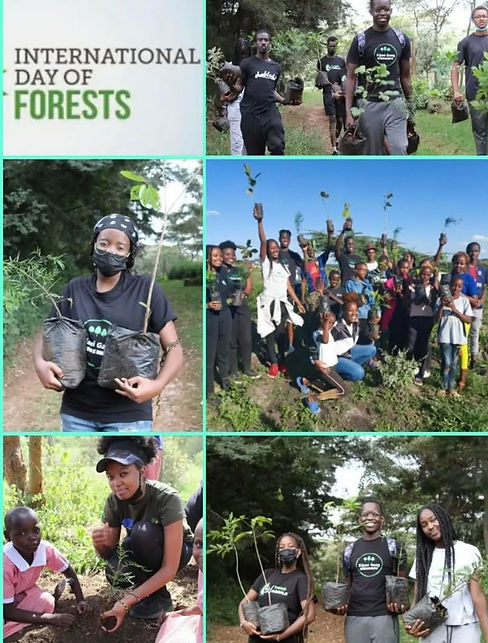
Tree Planting: Our ongoing initiative expanded beyond our family tradition, growing into a movement that has planted over 4,000 trees with the help of schools and community clubs.
-
TreesForGoals: Sports enthusiasts committed to planting trees for every goal they scored, blending athletics with environmental impact.
-
KijaniTech: Young tech minds tackled e-waste recycling, collectively repurposing over 6 tons of discarded electronics.
-
ArtForChange: Students passionate about art used recycled materials to create powerful, thought-provoking pieces, spreading awareness about climate change through creative expression.
To ensure these efforts reached the next generation, we also founded a Green School in our local community, educating children ages 7-14 about climate action and engaging them in our initiatives. Through fundraising, we installed water-harvesting gutters and provided learning materials for students preparing for exams—proving that sustainability and education can go hand in hand.
Through Kijani World, I’ve had the privilege of representing Kenya at COP24, collaborating on policy development with the Cabinet Secretary of Natural Resources, and co-authoring research on Indigenous voices in climate policy. What started as a family tradition has grown into something far bigger—a movement that proves climate action is not just about fighting a distant crisis, but about integrating sustainability into the things we already do, love, and celebrate.
Ghetto Classics – Empowering Through Music
I started learning piano at a young age, but when my school stopped offering music classes, I lost access to formal training—and with it, a part of my confidence. Without music, my sense of identity became tied solely to academic performance, and every mistake felt like a measure of my worth. It wasn’t until I changed schools—one that embraced the arts as an essential part of education—that I rediscovered my passion for music. I realized that students are not static; they thrive when given the space to explore multiple interests.
Wanting to help other students experience the confidence and self-expression that music had given me, I began volunteering with Ghetto Classics, a program under the Art of Music Foundation dedicated to empowering children from disadvantaged backgrounds through music education. As the youngest teacher in the program, I led classes in recorder and piano for students aged 7-14, helping them build both technical skills and self-belief.
Beyond teaching, I took on a mentorship role, guiding students through the same journey I had—from uncertainty to self-discovery through music. Many of my students later auditioned for the Safaricom Youth Orchestra, one of Nairobi’s most prestigious ensembles, opening doors to scholarships and higher education opportunities. Seeing them grow into their talents reinforced my belief that music is not just an art form—it’s a tool for empowerment, resilience, and opportunity.

African Leadership Academy
I was selected as part of the top 3% of applicants to join the African Leadership Academy (ALA), an exclusive post-secondary program dedicated to shaping Africa’s future leaders. At ALA, I immersed myself in African Studies, gaining a deep understanding of the continent’s history and future potential, Entrepreneurship, where I developed my own business model, and Writing & Rhetoric, refining one of the most critical skills for leadership—communication.
Beyond academics, I was actively involved in Debate, Interact, Dance, and Art, but my most meaningful contribution was co-founding YANA (You Are Not Alone), a student enterprise created during COVID to support mental health and well-being. With students isolated in their boarding rooms, we built safe spaces for open conversations, collaborated with the counseling department, and even sold plants as symbols of wellness. Additionally, I played a key role in building the ALA Model African Union, a global conference where students across Africa debated and presented solutions to pressing international issues—leading its marketing efforts to expand its reach.
